
Roman Faith and Christian Faith - Teresa Morgan
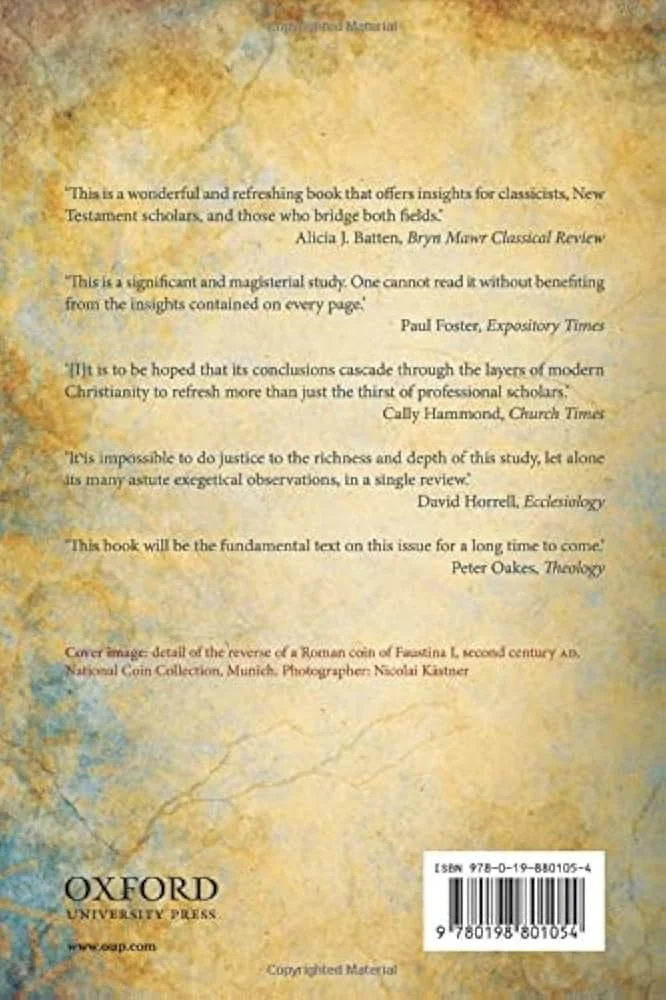
I read a REALLY big book. Roman Faith and Christian Faith is a 626-page behemoth that closely resembles a word study. I say “closely resembles” because Morgan insists on calling a “thematic study” of the idea or concept of “faith” as represented by the Greek pistis and Latin Fides. I picked up this book because one of my favorite authors, Matthew Bates (author of Salvation by Allegiance Alone, and Beyond the Salvation Wars), frequently refers to this work when making his case that that pistis (The Greek word most commonly translated “faith” in the New Testament) should primarily be understood as “allegiance” in many New Testament contexts. His claim is bold and paradigm-challenging, and I wanted to do the academic work of investigating it further. I now feel like I have done so. Morgan’s book is the most academically challenging work I’ve read since I knocked out the first couple volumes of Roberts & Donaldson’s Ante-Nicene Fathers fifteen years ago.

Morgan’s work essentially takes the form of a really long TDNT (Theological Dictionary of the New Testament) entry, which is why I say it closely resembles a word study. She begins by examining – exhaustively – uses of pistis/fides in antiquity in various contextual categories (domestic and personal relations, structures of state, and Graeco-Roman religiosity). While moving through each category, she is cumulatively building a thematic construction of this word group (which she argues is not significantly differentiated between the Greek/Latin languages). She then turns to Septuagintal uses of pistis, where she finds general continuity with non-canonical antiquity and explores when and why and when not and why not pistis is used to translate the Hebrew word emunah. Then the last 400 pages of the book are spent on an analysis of nearly every appearance of the word in the New Testament, which explores how the thematic construction that she has built earlier in the book is deployed and developed in the Scriptures.
An interesting point that Morgan makes in her study of pistis/fides in antiquity was that there was never any cognition in those cultures that the gods might not* exist. In such a world, it would be virtually impossible for “faith” to mean anything like “belief in the existence of a God” as we sometimes imagine it today (p. 160). It simply could not possibly have carried that meaning in the first century. I’ll share a quote where Morgan summarizes her analysis of pistis in antiquity
“Throughout this study so far we have focused on the relationality of pistis and fides, investigating the distinctive shapes of divine-human and intra-human pistis/fides… That relationality is central to concepts whose foundational and most common meanings are trust, trustworthiness, and faithfulness, and among whose more specialized meanings are goodfaith, assurance, pledge, and anything entrusted, needs no demonstration. In studies of pistis/fides by classicists as we have noted, relationality has always been central and uncontroversial. …Relationships of pistis/fides are more often than not expressed in action, and most historians of pistis/fides take the view that it needs* action, does not imply any particular state of mind or heart, and that the interiority of actors is not historically significant. The pistis/fides of a slave to his master, for example is usually understood as consisting essentially in certain forms of obedient behavior.” (P. 444-445)
Morgan’s one-sentence summary of her argument is provided in her introduction
“[faith] is, first and foremost, neither a body of beliefs nor a function of the heart or mind, but a relationship which creates community.”
Her New Testament analysis portrays Jesus at the center of a dual, bivalent “nexus of trust(pistis) between God and mankind”. She establishes the possibility of pistis/fides working that way in antiquity on page 101:
“We have seen how, in a two-way relationship, pistis/fides is characteristically bivalent, referring to the trust and trustworthiness of both sides and often fitting complementary aspects of pistis/fides together in a social “jigsaw” pattern. When someone in the middle of a three-part relationship has pistis/fides, this bivalency works in two directions. The mediator must be both trusting and trustworthy towards both parties in order to accomplish the desired relationship between them.”
And then establishes that this is how the New Testament portrays Jesus: as the centerpiece of a dual bivalent nexus of trust.
“Christ is therefore at the center of a nexus of divine human pistis. His pistis is simultaneously his faithfulness or trustworthiness towards both God and humanity and his trustedness by both God and humanity” (p. 272)
And
Christ is simultaneously faithful to and trusted by both god and humanity (not unlike a Greek or Roman mediator), and that location enables him to restore humanity to a relationship of dikaiosyne with God. (p.507)
She uses this depiction of pistis to argue that “pistis Christou” in the New Testament should be, wherever possible, understood as BOTH subjective and objective. However, you can often catch her leaning towards the subjective reading, like on page 303 (Galatians 2 and Romans 3) and page 442 (Revelation 14:12).
Now I’ll list some of the important observations made in her study of canonical pistis
1. “Pistis and fides are fundamentally relational concepts and practices, centering on trust, trustworthiness, faithfulness, and good faith, before broadening out to the (other) reified meanings.” (p. 503)
2. The other ‘reified” meanings of pistis that come from trust include persuasion, assurance, pledge, credit, argument, proof, and a safeguard” (p. 395)
3. Paul’s pistis is active/relational - not primarily interior (p. 467), and the interiority of pistis “does not attract much interest in the first century” (p. 503)
4. In Greek and Roman usage, pistis is never* an emotion (p. 449). It is better understood as a virtue (p. 465, 501)
5. Propositional belief (though always implicit in its relationality and not infrequently articulated or alluded to) is not* usually the focus of pistis in the New Testament (p. 444)
6. “When Abram is credited with dikaisyne (righteousness) by pistis, he was surely heard by Greek speakers as being credited with more than a personal relationship with god. He was marked as electing to play his part in the establishment of the society which would grow out of his offspring and become Israel.
7. The New Testament often describes Christians as hoi pisteuontes, which is often translated “those who believe,” but “no Greek speaker would have coined the term hoi pistoi to mean ‘those who believe’ (because propositional belief was not really a feature of the pistis theme in their world). If, however, both hoi pistoi and hoi pistuenotes were coined to mean primarily ‘those who trust/the faithful’, there is no grammatical oddity or ambiguity in self-characterization to explain. (p. 240)
8. “Pistis is therefore a relationship which brings a certain status and membership of a community” (p. 469)
9. “Ritual affirmations” of pistis/fides were a common feature in antiquity. (p. 99)
10. One major difference between New Testament pistis and the pistis/fides of antiquity is that the New Testament is relatively uninterested in exploring the relationship of pistis between believers, whereas antiquity is intensely interested in the word at that level. (p. 259)
11. Morgan’s translation/amplified-reading of the famous “faith” passage in Hebrews 11:1 is as follows: “the divine-human relationship of pistis is the foundation (in two senses) of everything human beings hope for, the proof of everything (which God has promised) that they have not yet seen. (There follows a series of examples that put their trust in God in this way and were not disappointed.)” (p. 340)

12. Both Paul and Luke use pistis (faith) and hypakoe (obedience) as virtual synonyms (Acts 6:7, Romans 1:5 & 16:26). She here imagines Luke being influenced by Paul’s understanding (p. 389) The “Obedience of faith” is best read as a genitive of apposition referring to Paul’s sense that the pistis into which he bring gentiles is, like his own, a relationship of slavish obedience to Christ.” (p. 282)
13. “Where Paul uses pistis language to try to clarify and define the relationship between God, Christ, and the faithful, the synoptic Gospels, as we will see, use it rather to express the complexity of Jesus’ identity and status, and the complexity of the divine-human relationship when Jesus is involved.” (p.349)
14. Through the Gospels, “Jesus challenges people to have pistis, commends people for having it, and criticizes people for not having it” (p. 374)
15. When the Gospel writers portray a lack of faith among Jesus’ hearers as the reason why Jesus could not perform miracles, there is no obvious reason why an attitude in the hearts or minds of his fellow-townsmen should affect Jesus’ power one way or another. If, however, we think of pistis as a relationship, it is possible to understand how God’s power reaches human beings through* relationships of pistis which connect human beings with God and Jesus and Jesus and God with another… Pistis has emerged as a divine initiative to which human beings are invited to respond and which enables the power of God to work through them in the world. (p. 358)
Sometimes reading this book was a slog. It’s tough to read through 100 pages full of non-conical usus of pistis/fides in antiquity, knowing you still have 400 pages before you can put the book down! But I’m glad I did. I really feel like I can speak on the topic of Faith in scripture from a position of relative expertise now, and I’m grateful to Teresa Morgan for getting me there.
I think that Morgan’s most significant contributions in this book are:
Establishing the possibility (using pistes/fides language in antiquity) that a mediator could function as an intermediary in a bilvalent relationship of trust, and then going on to show that is how the New Testament uses pistis language to describe Jesus.
Establishing that first-century pistis is primarily relational instead of interior.
Establishing that propositional belief is only a secondary, implied feature of pistis in the New Testament world and text.
This book does not make Matthew Bates’ argument for him. Bates takes Morgan’s work and then insists that the New Testament is using the pistis/fides theme primarily in its royal/political context because of its persistent repetition of Jesus as the “Christ.” In that context, the “allegiance” dimension of the trust relationship nexus really would take center stage, and the kind of interiority and propositional affirmation that has prevailed in this subject since the reformation would truly be a misstep. It is up to the reader to determine if this is really the correct mode in which pistis is being deployed in the New Testament, as Bates claims. I think that it might be.
I’m all caught up on book summary/responses. I’m currently 60 pages into God’s Homecoming by NT Wright, and still working through The State of New Testament Studies one chapter/article at a time. Up next for me are:
Paul’s “Works of the Law” In the perspective of Second-Century Reception. Matthew Thomas, 2020
From Genesis to Junia. Preston Sprinkle. 2026