
February 2026 Catch-up
I have really been slacking on my personal commitment to review each book that I read. I really want to tell you guys about the most recent book that I finished (Roman Faith & Christian Faith, Teresa Morgan), But there are a handful of books that I read before that, and I feel like I should briefly reflect on them before they get buried on my shelf: Here is what about three months of reading consisted of in the fall & winter of 2025:
One PHD dissertation:
“The Binding/Loosing of Satan in Jewish and Christian Apocalyptic with Special Reference to Revelation 20:1-10” Brian Patterson (Columbia Biblical Seminary, 2024)
One journal article:
“A Faith Unlike Abraham’s: Matthew Bates on Salvation By Allegiance Alone,” Will N Timmins (Journal of the Evangelical Theological Society 61.3, 2018, 595-615)
Three books that I read:
On The Apostolic Preaching - Irenaeus of Lyons (~185 AD)
The New Testament World in Its Ritual World - Richard E. DeMaris (Routledge, 2008)
Baptism According to Scripture - Bobby Harrington (College Press, 2025)
& Two Books that I listened to:
The Widening of God’s Mercy - Richard & Christopher Hays (Yale University Press, 2025)
The Unseen Realm - Michael Heiser (Lexham Press, 2015)
These deserve more time than I’ll give them below (especially Brian’s dissertation, which was GREAT), but because I am so far behind on this task, this is all the space they'll get. As usual, I’m not really writing reviews - It’s more of a personal response with a tiny bit of summary. I’m going to do that for Brian Patterson’s dissertation and the three books listed above that I read. You’ll just have to ask me about the other works. I listened to The Unseen Realm and The Widening of God’s Mercy as a means of shortening my “read next” pile. I have a lot of thoughts about both of them that I would really like to write down, but also, a job. If you want to talk about them sometime, coffee is on me.
The Binding/Loosing of Satan in Jewish and Christian Apocalyptic with Special Reference to Revelation 20:1-10 - Brian Patterson (2024)
This was an excellent study on the binding and loosing of Satan in Revelation 20. This issue/text is ground zero for the “millenarian” debate in eschatology. The interval between when I read this and when I’m writing this paragraph has been far too long. I remember Brian’s exhaustive survey of how this text has been read. I was most interested in the survey that he provided of millenarianism among the early Church fathers. This is an area where I am relatively well read, but could not produce from memory any indication of millenarianism from those works. Brian is better read than I and does a great job pointing out where the eschatological understanding of these authors emerges. Here is an excerpt from his conclusion on that subject
The overall conclusion of the fathers seems to be that 1) the church fathers were often premillennial, though likely not dispensational, 2) there were those Christians who held different views, possibly an allegorizing akin to amillennialism, which likely led to Augustine’s view, and 3) No view seems to be able to declare itself to be the official view of the church fathers.
I was SUPER intrigued by a line that Brian wrote on page 158 (page #’s from the PDF doc) when discussing the importance of the early Church Fathers’ testimony on the topic:
There is certainly logical room for the argument that earlier writings better reflect the beliefs of the early church than later writings. But the authority of those earlier authors needs to be applied consistently across the author’s theological spectrum.
I think that is a super keen point to make on this topic. Where some may wish to slam-dunk their eschatological position with ECF testimony, Brian cautions that they would need to give equal weight to other theological positions taken by the same authors with which they might not be as comfortable. One could imagine John McCarthur appealing to Justin Martyr’s premillennialism but not being equally willing to endorse his baptismal regenerationalism or infamously non-reformed position on election and good works. At the same time, these words are a challenge to me personally, who prefers Justin’s perspective on those latter matters, to wrestle with the fact that they likely did not hold the eschatological understanding which I lean towards.
Brian counters the premillennial perspective of some of the earliest Church fathers with that of Augustine (and others) to point out the balance of perspectives on the millennium within the Early church, but I must contest that move. Chronologically, calling Augustine an early Church father is roughly equivalent to counting myself among the founding fathers of America. It makes me upset when calvinists do this to advocate their position on original sin, so (using Brian’s page 167 standard) I need to object when a similar appeal is made on the subject of eschatology.
Brian weighs the various positions on the binding and loosing of Satan with skill and concludes that the Bible portrays Satan as being currently bound in a limited sense because of the victory of Jesus, but that binding will one day be loosed before the return of Christ (if I remember this all correctly from so long ago…). Here is a quote from page 261 :
Satan’s binding was described as not being an “all or nothing” binding where Satan can either do everything when unbound and nothing when bound. His binding began at Christ’s first coming and continues today. Satan is allowed to work against the church and persecute the church, but will never have the influence and power to turn the entire world against the church. Therefore, the church will continue to exist until the end, despite Satan’s best efforts.
I was sharpened and challenged by Brian’s work. I find myself agreeing with his conclusions. I really hope this is made into a book. and Brian earned his way into having his name written into the margins of my personal Bible in a couple places because of some insights that he made here which i and really do not want to forget.
On the Apostolic Preaching - St Irenaeus of Lyons ~185AD
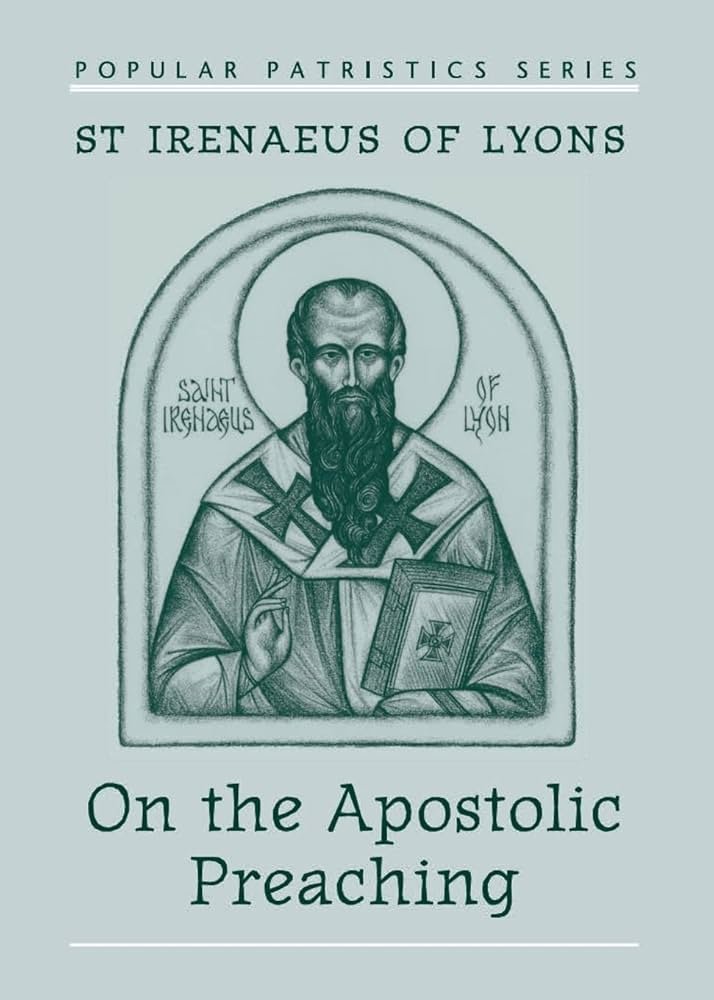
I had read all of Irenaeus’ writings in the classic Roberts & Donaldson set of the Ante-Nicene Fathers’ works. But in Beyond the Salvation Wars, author, Matthew Bates, was pointing out just how recently discovered some of the very significant pieces of early Church literature are, and he mentioned that On the Apostolic Preaching was published recently enough to be left out of the classic set, and I realized that I was missing of piece of the Irenaeus of Lyons corpus so, of course, I ordered it right away and fixed that. This work was probably written around 185 AD. Returning to the second-century fathers in this work provided another stark confrontation with the fact that the theology given by the apostles to the earliest believers is severely incongruous with several aspects of reformed theology. The way they use the word faith and speak of faith is FAR less interior than reformed theology would allow. The response of faith is volitional, and the discussion of election is suspiciously absent. And the sacramental understanding of baptism is severely different than that constructed by the Calvin/Zwingli branch of the Reformation. Here are some quotes:
“Therefore, lest we suffer any such thing, we must keep the rule of faith unswervingly, and perform the commandments of God” (p. 41)
“as the disciples of the apostles have handed down to us: firstly, it exhorts us to remember the we hav received baptism for the remission of sins, in the name of God the Father, and in the name of Jesus Christ, the Son of God incarnate, and died and was raised, and in the Holy Spirit of God; and that ths baptism is the seal of eternal life and rebirth unto God.” (p. 42)
“For this reason, the baptism of our regeneration takes place through these three articles (trinity), granting us regeneration unto God the father though His Son by the Holy Spirit.” (p. 44)
“for thus do the faithful keep, having the Holy Spirit constantly dwelling in them, who was given from God at baptism and kept by the recipient living in truth and holiness and righteousness and patience;” (p. 67)
“Wherever anyone of those who believe in Him and do His will shall call upon Him, He is present, fulfilling the petitions of those who call upon Him with a pure heart.” (p. 99)
The New Testament In Its Ritual World - Richard E. DeMaris (2008)
starts by confronting the idea popular in Reformed Christianity that ‘ritual’ in the New Testament is purely communicative (think “outward sign of an inward change”), he quotes Gorman to set the tone for why this concept of NT ritual falls short:
Such a referential, symbolic, and linguistic appraoch fails to take seriously that ritual is activity and embidied encactment. Sperber suggests that ritual is evocative rater than communicative… These theoritsts agree that ritual enactment refers to itself and not to a message that exists apart from, outside of, or above the ritual enactment proper.” (p. 7)
DeMaris spends most of the book looking at one ritual example, baptism. He explores the problems with understanding NT baptism as a purification or entry rite, and then asserts that it is best understood as a funerary rite of boundary crossing that most significantly enacted the death-to/departure-from previous way of life and social ties.
““Ritual is a means of performing the way things out to be in conscious tension to the way things are” (smith, 1987). In the case of baptism, it would have concretized, enacted, and finalized the departure of indificuals from their former social identity and their entry into a new identity.” (p. 31)
He spends considerable time exploring the baptism for the dead mentioned in 1st Corinthians 15, which he suggests was a practice that the Corinthian Church was performing for ALL believers upon their death to signify their boundary crossing out of the community of living believers!
“Perhaps it is more acurate to thing of the boundary-crossing as a movement from the circle of the living to the circle of dead within the church. As an entry rite, baptism on behalf of the dead would have confirmed the departure of deceased community members from the circle of the living and enabled their entry into the community of the dead (p. 64)
Baptism According to Scripture - Bobby Harrington 2025
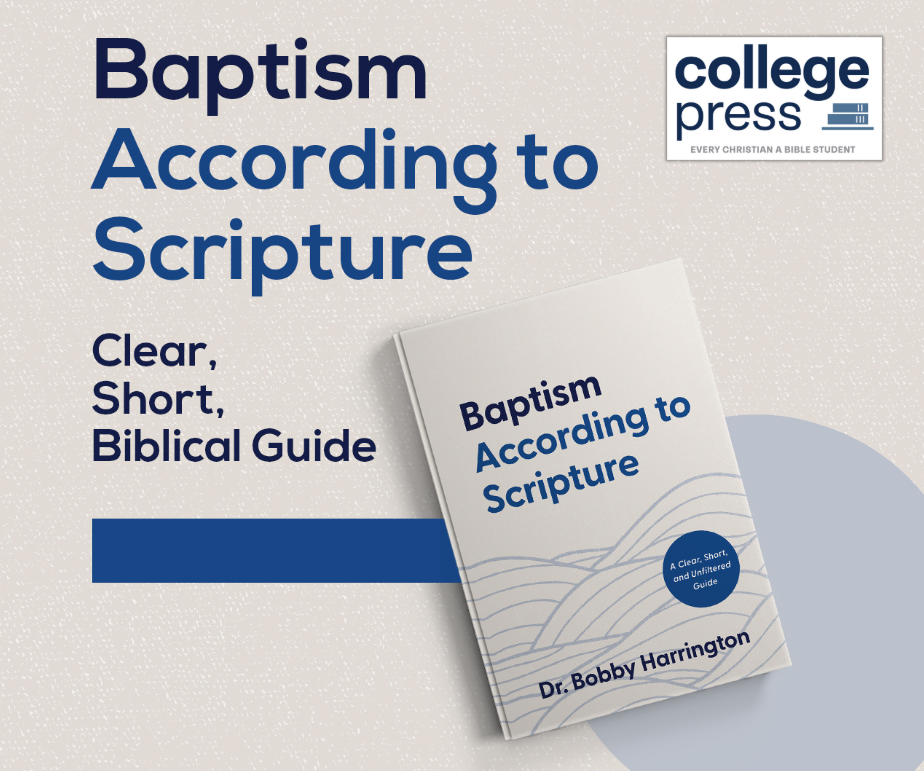
This is a short little book (50 pages) that basically presents the generally accepted understanding of baptism within the Restoration Movement churches by the CEO of the newest publishing and networking powerhouse within that movement (Renew.org). Not many surprises here. As always, when you take the New Testament material on baptism and attempt to synthesize it into a work of modern theology, you are going to end up saying things about baptism that the text itself does not explicitly say. That makes work like this tenuous. As I’m reading it, I can already imagine the objections of Swiss-Reformed readers who would wish to counter with their own not-explicitly-in-the-text assertions about baptism. I think works like this need another dimension, which is why I am a big proponent of bringing the writings of the Early Church Fathers to bear on this subject, even in a book as concise as this one. What can mediate or decide between these two (restoration vs. reformed) syntheses of the Biblical material on baptism? I think that the pre-canonical testimony of the Early Church Fathers can do that because it gives us an insight into the content/nature of the kerygma in its earliest (most authentic - least distorted) form. The weight of the ECF testimony would land squarely on the side of Dr. Harrington’s position against the reformed view of baptism, and I really wish that he had appealed to it.
“Baptism is the way scripture teaches us to express our faith in Jesus as a personal decision.” (p. 12)
“Baptism’s benefits come through your faith in the working of God.” All of these passages demonstrate that the act of baptism is not a human work, but the ceremony God gave us to be our expression of faith in Jesus.” (p. 15)
“The baptism ceremony is the method God designed to express our faith and commitment to him in a concrete moment.” (P. 16)
“Jesus teaches that baptism marks our transition into the new life in his (present) kingdom, where we will live as his faithful disciples until the end of life. Understood this way, baptism is not the finish line but the starting line.” (p. 33)